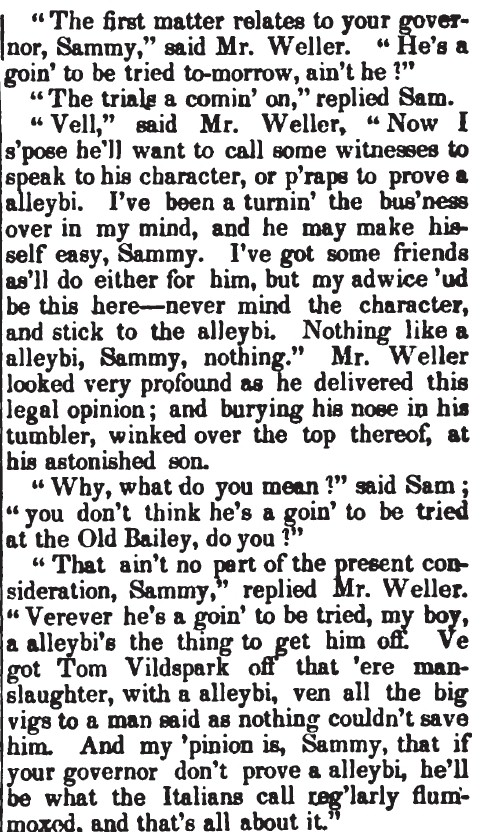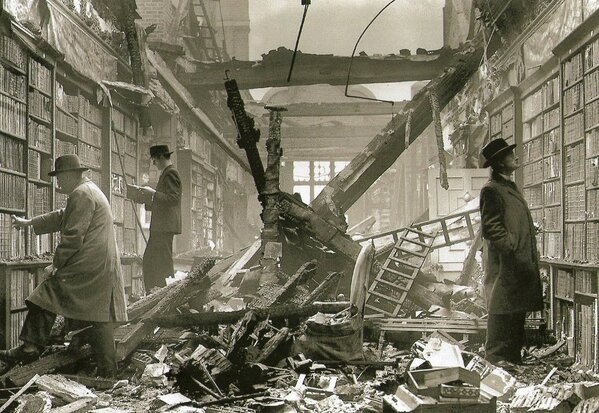
Business as usual in the Alibi Library despite the frequent air raids. (H H library, London, after a German bombing in October 1940)
Business as usual in the Alibi Library despite the frequent air raids. (H H library, London, after a German bombing in October 1940)
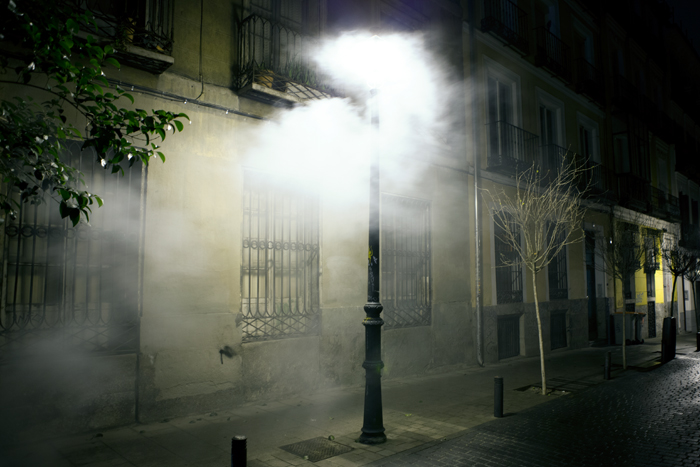
These images from the ever excellent intervention artists Luzinterruptus, show us the dreary underbelly of Madrid, the sort of sinister place where the underworld and government ministers might mix in murky schemes. Smoke as a form of protest. No smoke without fire….
 Brings to mind this description from Dickens´ London:
Fog everywhere. Fog up the river, where it flows among green aits and meadows; fog down the river, where it rolls defiled among the tiers of shipping and the waterside pollutions of a great (and dirty) city. Fog on the Essex marshes, fog on the Kentish heights. Fog creeping into the cabooses of collier-brigs; fog lying out on the yards, and hovering in the rigging of great ships; fog drooping on the gunwales of barges and small boats. Fog in the eyes and throats of ancient Greenwich pensioners, wheezing by the firesides of their wards; fog in the stem and bowl of the afternoon pipe of the wrathful skipper, down in his close cabin; fog cruelly pinching the toes and fingers of his shivering little ’prentice boy on deck. Chance people on the bridges peeping over the parapets into a nether sky of fog, with fog all round them, as if they were up in a balloon, and hanging in the misty clouds.
Bleak House
Or this from T.S. Elliot:

“The yellow fog that rubs its back upon the window-panes
The yellow smoke that rubs its muzzle on the window-panes
Licked its tongue into the corners of the evening
Lingered upon the pools that stand in drains
Let fall upon its back the soot that falls from chimneys
Slipped by the terrace, made a sudden leap
And seeing that it was a soft October night
Curled once about the house, and fell asleep”
 ― T.S. Eliot,  The Love Song of J. Alfred Prufrock and Other Poems
Visit Luzinterruptus on http://www.luzinterruptus.com/ to find out more about their projects.
The Alibi Library has decided to publish a little of its correspondence in homage to another somewhat more famous book also set in the Charing Cross Road:


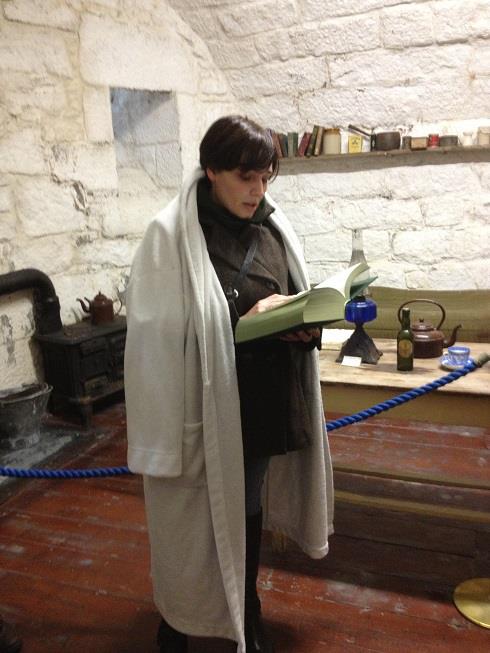
Love this video from the Bloomsday Survival Kit who incidentally are reading a little bit from Ulysees each week. The first reading was on Sunday 27th Jan at the Martello Tower in Sandycove where the film was made.
Find the Bloomsday Survival Kit on Facebook:
Self Portrait as God
My head spins so fast
that my thoughts have a kind of gravity.
My greatness is such that
I have to stoop, have become crooked.
I can’t sleep
for the sound of my own breathing.
Everyday I amaze myself
which isn’t really surprising.

But, Henry couldn’t face the idea of going back to the underpass for the night, or having anything more to do with the people in it. Really if they were going to sleep anywhere, they needed some kind of back yard., a back alley or car park. A place where lorries would load and unload. A place without street lighting. A place with the corners piled high with crates and cardboard. Huge bins stinking with rotten apples. Sacks and polystyrene.

Kim quickly established herself as leader again, and they entered a maze of strange smelling streets which led away from the bright gaudiness that was Piccadilly and into another darker, closed in kind of world. Here, from behind the buildings, the traffic sounded fainter. Henry looked at the doors. Even in the dark rainy night he could just make out the features of some of the doors. He scrutinised them for clues. And doors have secrets; and know how to conceal stories. They have important things to say to people who want to go in or out, and even for people who need to bed down in front of them.

But Henry knew doors more as exits more than as shelters. He didn’t really know which would make the best place to bed down, though he was prepared to make a guess. He tried to make them out. He could see even at a glance, which doors were used regularly, and discounted others because they looked too formidable. He was looking for an unloved, unwanted, half-forgotten door. He knew that a door with weeds growing on the step, with an old rusty lock, blackened hinges, cracked painted panels, broken glass, splintered or worm-eaten wood, would be the perfect place; a door which probably no longer opened or if opened might never close; a door which had almost become a part of the wall. A door that was no longer needed, indeed no longer a door: An unnecessary door. And in time an invisible door.

The first door that seemed to satisfy Henry’s criteria stank of piss. The second was too exposed – two kids could turn a vacant doorway into a spectacle. Even an invisible door might be seen, if there were two invisible children sleeping in front of it.

Kim found the right door. She had stood next to it patiently while Henry had been deliberating. It almost seemed as if she had an instinct for these things. Henry had to concede a certain admiration for her, she certainly knew her way around. First she had led them into this area of back alleys and cul-de-sacs. Then she had found them a good place to bed down and rest. She had an uncanny gift. Although this door met with his approval, he set about making, as he saw them, improvements. Instead of pulling out the knee-high thistle and dead foxglove, he simply pulled them forward, and with big pieces of dry flattened cardboard boxes, he made a tent, so that they would not be seen at all. Behind these boxes, sheltered from the rain by the portico, he made a narrow bed of cardboard over the nettles.

Kim lay so close behind Henry, that once again he could feel her quick breath on the back of his damp neck. And Henry felt himself slipping away, and for a moment he was spiralling downwards, falling, falling, falling, before catching another thermal and swooping up into the clouds. But suddenly he was awake. And then wide awake. He knew he had heard a movement. A tap, tap, tap. The hair on the back of his neck stood on end. He felt suddenly the need to shiver violently. Automatically he looked down at his watch. Even in the half light he could see that it had stopped. Now, he heard a new noise. The rasping of a claw over stone and a chain against metal. He struggled to control his breath. If he could only control his breathing, he knew he might not be found. He felt a movement next to him. Kim! Lay still! Stay still. The whole of his body concentrated on trying not to move a muscle, his mind occupied in trying to telepathically make Kim somehow do the same. But then there was another movement behind his back and Henry heard a dismal click, a dreadful scraping and a sudden rush of air, as then something finally gave and he felt himself falling, something jabbing into him one, two, three times, as he fell away into the blinding light. And a voice.
“Two boys.”
Henry scrambled so quickly to his feet that his head swam. His legs, numb with the cold, barely held him up. He swaggered from side to side, struggling to make out where he was and who had spoken. The light that had at first seemed so bright, now that he became accustomed, appeared in reality to be weak and thin and wholly inadequate for this interior space.
Kim was standing too.
“Not one, but two. A wild one. A scamp and a scout. What is your home? Have you come far?” asked the voice laughing now.
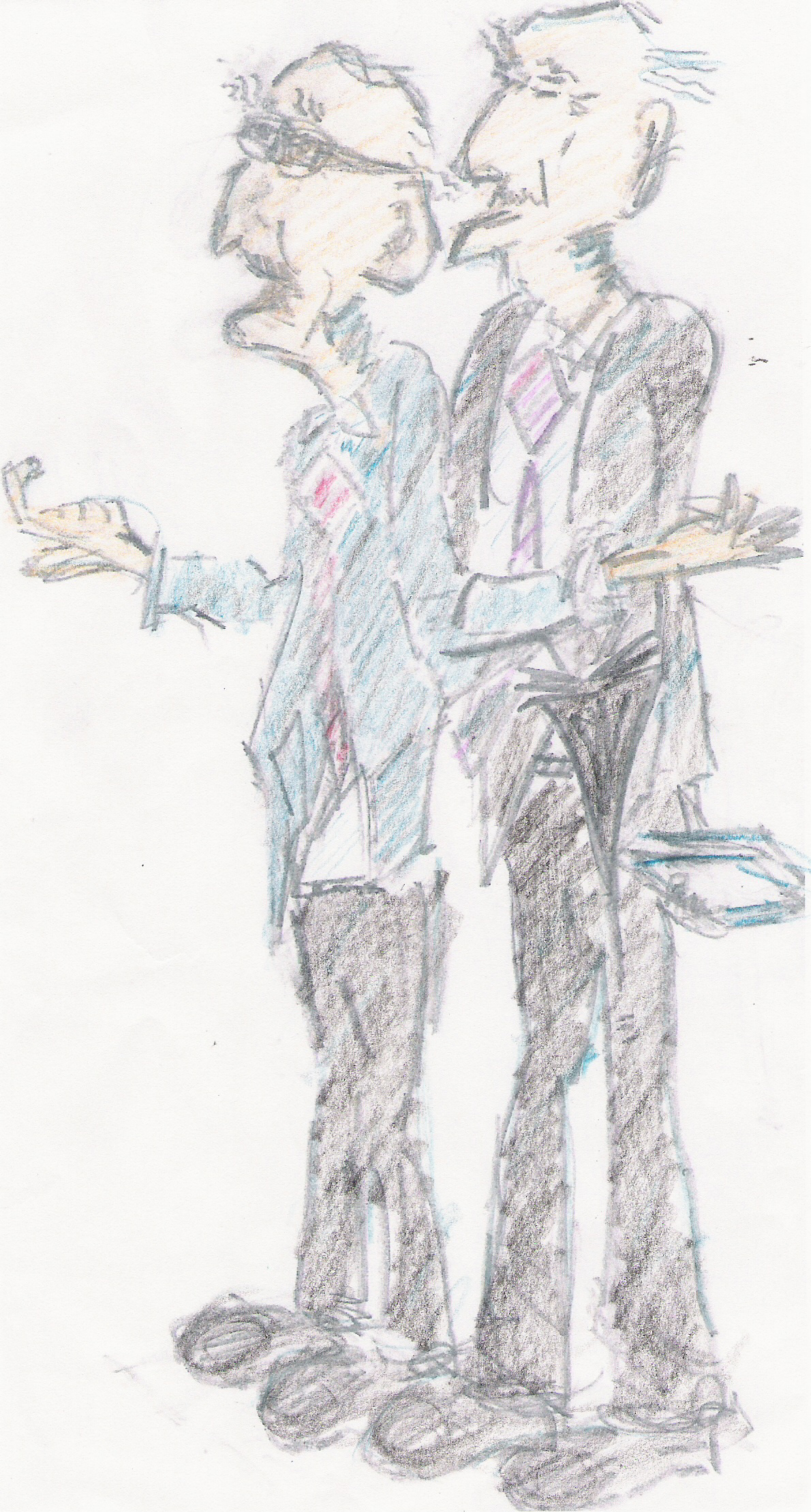
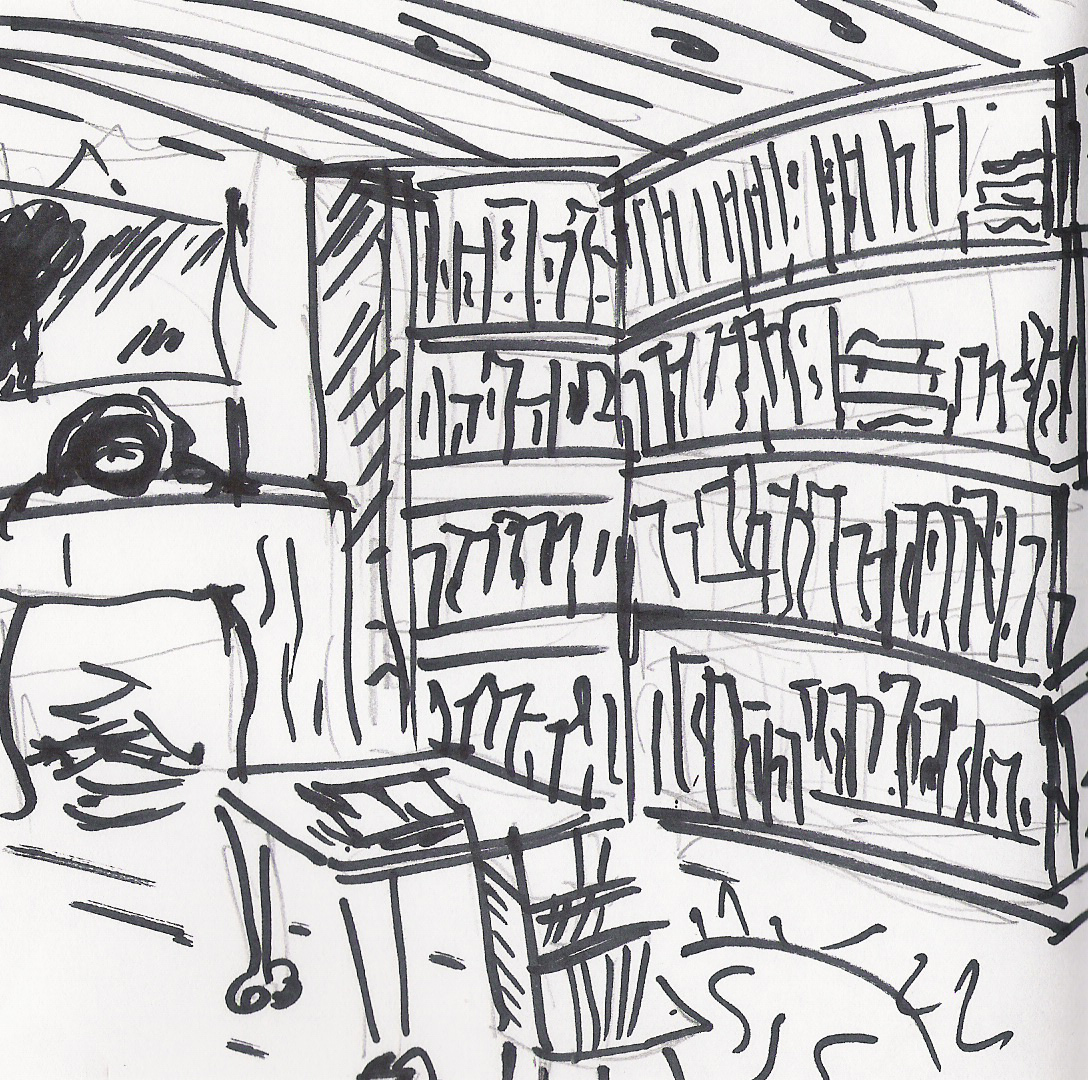
Henry looked at where the voice was coming from. Two spindly wiry men, who to Henry’s mind looked positively spider-like, stood wheezing from the effort of their laughter among the cobwebs of the black cellar room. In the middle was a table with cards and two glasses, a bottle of something pale and honey coloured which Henry recognised as a particular favourite of his mother. Around him were piles and piles and piles of books piled high to the ceiling and bundles and bundles of newspapers and notebooks bundled together. The ceiling itself was low giving the whole room a cramped and claustrophobic feel. This was some kind of stockroom for a booksellers or a manuscript archive or something of the kind.
The books looked old and well thumbed. The colours of their spines were dulled to the point that, in the half light, it was impossible to tell which was green from which was blue. In this subdued light, the books which under a spotlight or the interrogation lamp would hardly command any attention seemed practically to blend with the walls. But Henry felt a curiosity towards them. What books were these, and who were their authors, that they could end up discarded in a cobwebby basement like this, with these two giant spiders for keepers.
“So this is Henry,” croaked one of the shabby gentleman, if gentleman they were. Henry could think of other words for them. Henry turned abruptly startled to hear his name. “Handsome, very handsome. For a boy.”
“To praise children is inauspicious,” the other thin man warned him in mild rebuke wagging his thin finger.
One of the men had climbed the four steps, down which Henry had just fallen, to close the door, which resisting, repeated the scraping sound, which to Henry had almost only been part of a dream world, but now seemed all too real.
“And the young Kim has been a great detective once again,” sang the first rustling her mop of boyish hair.” She grimaced and flapped her hands unsubtly in a belated attempt to quiet them.
“You know these men?” Henry was incredulous. But now at least he understood her uncanny good sense.
“Was he difficult?” enquired the other.
Kim sighed, resigned to the fact that her duplicity had been exposed, and her cover blown.
“He is quite mad, why should I lie to you,” laughed Kim. “But difficult? Not a bit. Sometimes he looks at me… I thought he was going to hit me, or push me into the canal… more than once.” She finished this last cursing like a cat under her breath and the taller thinner man admonished her tutting, while the other said,
“Oh, Kim! You sound as ignorant as a girl raised in the country when you curse!”
“But, he is here and he will stay here,” said Kim matter of factly, “and that is what you wanted of me.”

The men laughed, or coughed, or both, and then the tallest, thinnest man added, “we shall have to be careful though, not to go near any canals.” He was counting out five pound notes from the till, and after what seemed like he had counted a small fortune he handed them over to Kim, who began to recount them studiously. “After service comes the reward. Our little Indian spy. Greatest spy in Soho.” Then he added reflectively, “You know how to look after yourself at least.”
A transaction. Henry had been their transaction. He had felt sorry for Kim and she had betrayed him. But to who. Who were these men who seemed to know him?

Or, at best untunefully sung and, on occasions, out of tempo.
Therefore, the proprietors of the Alibi Library would like in this post to pay homage to a comrade in quills. The library could not possibly offer the assistance it does without the help of a close circle of friends and fellow enthusiasts. In particular, they would like to acknowledge the tireless work of friend and librarian, Julian6, and recommend his literary critiques to a wider audience. That said, Julian’s reviews have already been published by such dizzyingly celestial bodies as the Guardian Culture section online. And he has, indeed, been influential in bringing to the attention of the staff at these premises, works that have had a profound influence on the collection through his broad array of interests; Music, Writing, Reading, Movies, Softball , Birdwatching. In turn, Julian6 has borrowed and read from the collection of The Alibi Library.

An example of his fine reviewing can be found below:
James Kelman – How Late It Was, How Late
This book follows the troubled progress of an unemployed builder inhabiting the rougher parts of Glasgow. At the very beginning he is beaten up by the police and ends up in a police cell. He is later released but has apparently gone blind due to the ill treatment he endured. Much of the book follows his stumbling odyssey around Glasgow trying to survive. It is a very introspective work delivered in broad Glaswegian vernacular which actually far from being tedious is alive with drama thanks to the sustained brilliance of Kelman’s monologues and dialogues. Later in the book doubts and confusions emerge about what really happened to Sammy the builder and his past proves grimmer and more shady than it appeared at the beginning. The real strength of this work is the honesty and dramatic truth of Sammy’s inner life which is the book’s primary concern. The almost unreal stoicism he exhibits when confronting his blindness. No matter how grim his past may be and how culpable he is for the position he finds himself in – we tend to side with him as is often the case in works where the anti-hero is so direct and acute in his self-knowledge. Someone who knows themself remains stubbornly human even at their least attractive moments. The conclusion is especially moving although the dark clouds remain.
Visit his link on:

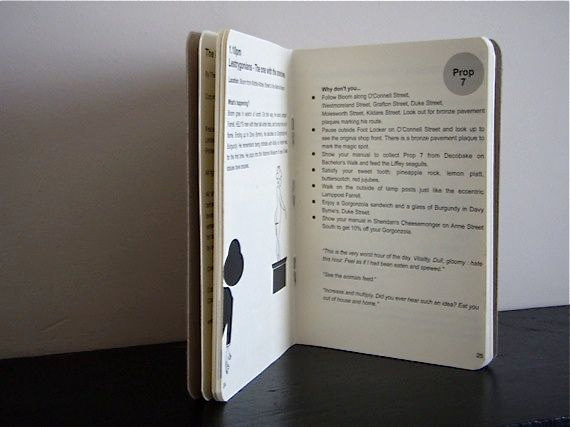

http://www.etsy.com/listing/105560183/the-bloomsday-manual-a-mini-romp-through?ref=pr_shop
http://www.bloomsdaysurvivalkit.com/
https://www.facebook.com/BloomsdaySurvivalKit
The word alibi, which in Latin means ‘elsewhere’, has been used since the 18th century to mean ‘an assertion by a person that he or she was elsewhere’. In the 20th century a new sense arose (originally in the US) with the meaning ‘an excuse’. This use is a fairly common and natural extension of the core meaning, but is still regarded as incorrect by some traditionalists.
noun (plural alibis)
verb (alibis, alibiing, alibied)
[with object]informal
Origin:
late 17th century (as an adverb in the sense ‘elsewhere’): from Latin, ‘elsewhere’. The noun use dates from the late 18th century
from the Oxford and Merriam Webster online dictionaries.
I’ve been trying to fit in for years. Yes. Yes. We’ve all been in the wrong place at the wrong time. For some it’s that deliciously blurred moment somewhere after midnight and before work or school the next day. On the other hand, some of us seem to spend most of our days there. And others appear to have been simply born there. Of course we can dissimulate. We can pretend we suddenly fit in though it’s as awkward as a suit with no arms and ten pockets when there’s a bill to be paid. But now I seem to conflating being in the wrong place with a sort of being-out-of-place faux pas. And even then, when we’re busy pretending that we’re not as out of place as a mathematical equation scrawled on a urinal wall, that’s when we need the alibi most. To fit in. Who am I. Where have I come from. As if I was ever going to tell you any of that stuff. Yes. Yes. I’ll come up with something to be sure,
better than the truth, or at least more believable.


 The Alibi Library